
ROBERT THE DOLL: The True Story Behind Key West’s Most Haunted Doll
By Staff Reports
🌙 FLORIDA AFTER DARK — Robert the Doll is the most famous haunted doll in Florida, and he may be the most famous haunted doll in the world. In a glass case inside Key West’s Fort East Martello Museum sits a smiling doll in a sailor suit. People fly in from all over the world to see him. Then they write him letters. Apology letters — by the thousands.
His name is Robert, and this is his real story.
Meet Robert the Doll, Key West’s Haunted Doll
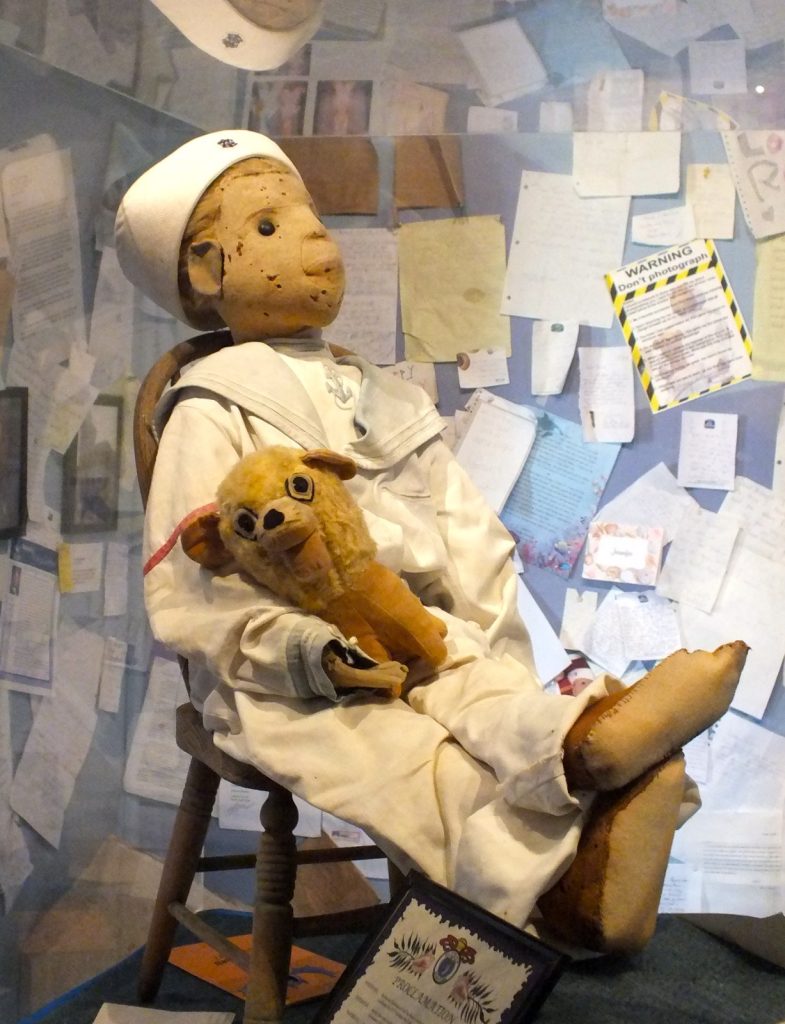
Robert is a genuine artifact: a handmade doll about 40 inches tall — the size of a small child — most likely made by Germany’s Steiff company around 1904 and stuffed with wood wool. He wears the sailor suit of the boy he belonged to: Robert Eugene Otto, called “Gene,” a Key West artist who grew up in the Victorian house on Eaton Street now known as the Artist House. Gene named the doll after himself, and the two were inseparable. As an adult artist, Gene kept Robert for life, painting with the doll propped nearby and giving him a room of his own in the house.
The Boy Who Said “Robert Did It”
Ask Key West old-timers and they will tell you Gene blamed the doll for everything. Broken things, messes, mischief in the big house on Eaton Street — “Robert did it” became the boy’s answer for all of it, and the phrase followed Robert for the next 120 years. Neighbors later claimed they saw the doll move from window to window. Visitors to the house reported giggling and small footsteps from empty rooms, and Robert turning up in places nobody had left him. Those accounts are legend, not record — but they started early, and they never really stopped.
What Is Documented — and What Is Legend
Here is where history and legend split. The famous version of the story says a Bahamian servant cursed the doll before giving it to the boy. Historians will tell you plainly: there is no record of that from the time, and researchers who have dug into Robert’s past — including a Skeptical Inquirer investigation in 2025 — traced him instead to Steiff, the famous German toymaker, where a doll like him would have been an expensive, custom-looking piece. What IS documented is stranger in its own way: the eerie stories about Robert moving around the house, changing expressions, and causing misfortune only really took off after Gene Otto died in 1974. The house’s next owner, Myrtle Reuter, eventually donated Robert to the museum in 1994, telling staff he was haunted.
The Apology Letters
And then the letters started. The rule at the museum is simple: you ask Robert’s permission before you take his picture. Visitors who photograph Robert without asking blame everything that goes wrong afterward on the doll — the folklore list includes car accidents, broken bones, job loss, divorce, and a cornucopia of other misfortunes — and then they write to apologize and beg him to lift the curse. The museum says the letters still arrive at a pace of one to three a day, thousands of them stacked up over the years, many of them pinned to the wall behind his case. He even travels: in 2008, Robert left Key West for the first time in his then-104 years, to appear at a paranormal convention in Clearwater — and came home to a fresh stack of mail.
Is Robert the Doll Really Haunted?
Is Robert haunted? The museum staff won’t say yes. They also won’t say no. Television investigators from shows like Ghost Hunters have come to Key West to test him, and a horror movie franchise loosely based on his legend has run to five films. What nobody disputes is the paper trail: a real, finely made German doll, a boy who treated him as a living friend for roughly seventy years, and a century of people who walked away from that glass case convinced they had met something they could not explain.
Visiting Robert the Doll in Key West
Robert lives at the Fort East Martello Museum in Key West, run by the Key West Art & Historical Society, where he sits on permanent display in his glass case in his sailor suit, holding his stuffed lion. You can visit him any day the museum is open — just remember the house rules: greet him, ask permission before you photograph him, and say goodbye when you leave. Thousands of letter-writers wish they had.
Robert the Doll: Quick Questions
Where is Robert the Doll? At the Fort East Martello Museum in Key West, Florida, on permanent display in a glass case.
Why do people apologize to Robert the Doll? Legend says visitors who photograph him without asking permission run into bad luck afterward — and write letters begging him to lift it. The museum receives one to three apology letters a day.
How old is Robert the Doll? He was made around 1904, most likely by the Steiff company in Germany, making him more than 120 years old.
More Haunted Places in Florida
Robert is the king of Florida After Dark, but he is not alone. Meet the ghost children of St. Augustine, still said to climb the lighthouse stairs, and step inside Cassadaga, the Florida town full of psychics. Browse the whole series in Florida After Dark.
Join the conversation: Would YOU take Robert’s picture without asking? And Florida — what have YOU seen that you can’t explain? Florida After Dark wants your stories: send them to tips@floridachatter.com and yours could be our next feature.
Sources: Key West Art & Historical Society; Fort East Martello Museum; Atlas Obscura; Wikipedia; Skeptical Inquirer (2025).
Photo: Cayobo, via Wikimedia Commons (CC BY 1.0) — Robert the Doll in his display case at Fort East Martello Museum, Key West, surrounded by visitors’ apology letters.
Pingback: A TOWN FULL OF PSYCHICS: Inside Florida's Mysterious Cassadaga - Florida Chatter
Pingback: FLORIDA'S HAUNTED HIGHWAY: Why Do People Call This Stretch of I-4 the Dead Zone? - Florida Chatter
Pingback: FLORIDA'S SPOOKIEST LITTLE TOWN? The Strange Stories and Haunted History of Crescent City - Florida Chatter